
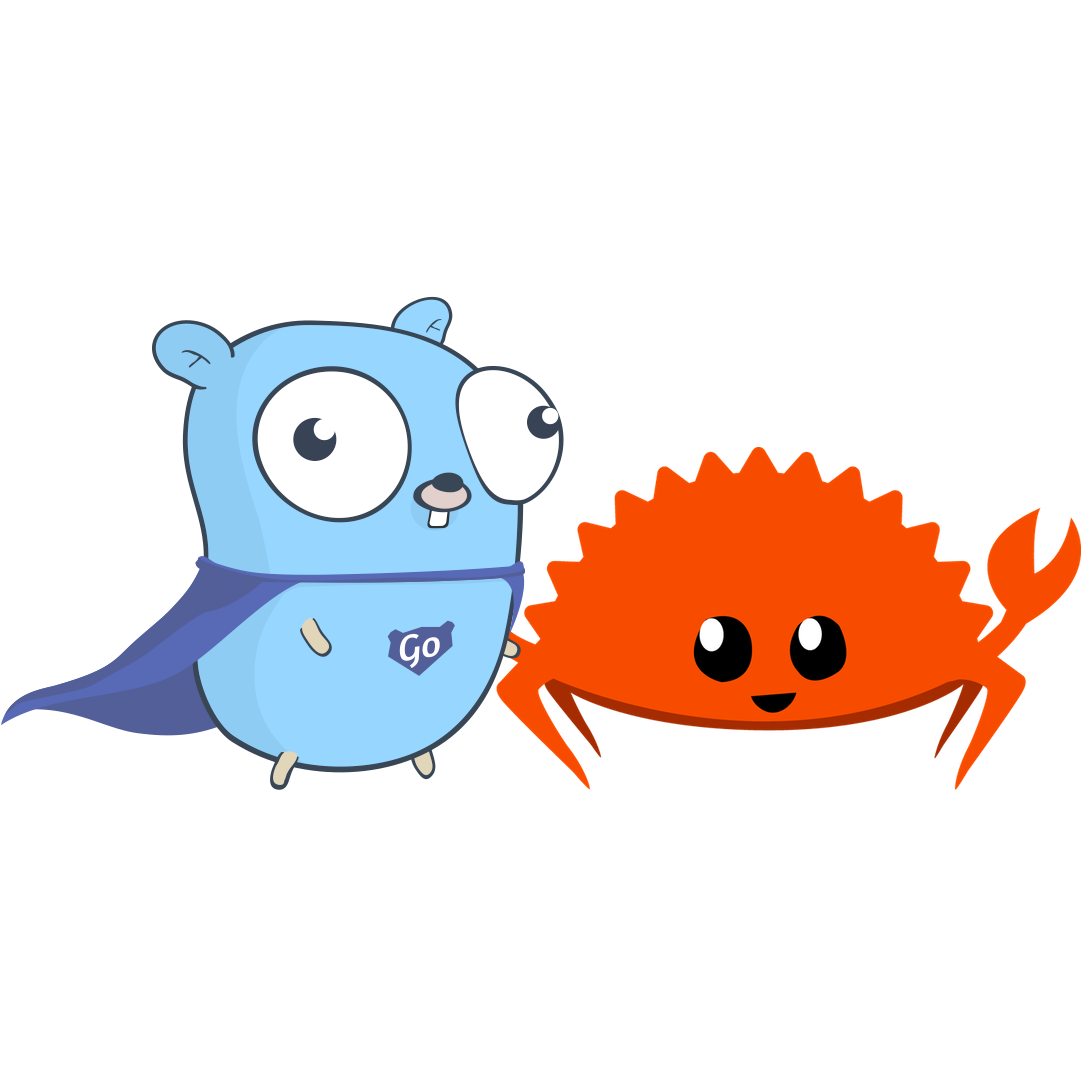
Rust vs Go

Rust and Go have many similarities, but also important differences. Which is right for you?
Rust is a powerful, rich, and rewarding language that prioritises safety and correctness without sacrificing power or efficiency. It’s ideal for building software that has to work and keep working.
Go is a small, elegant language that’s easy to learn and quick to write. Go lets developers move fast, while staying flexible.
In a bumper sticker:
Rust for high stakes, Go for low costs.
Here’s a quick overview of both languages, highlighting the important advantages of each, pointing out what they have in common, and showing where they differ in important ways.
If you’re a developer wondering which language would be better for you to learn, or a business considering which language to adopt from a strategic point of view, read on.
Common goals
Both Rust and Go are relatively modern languages, incorporating many of the lessons we’ve learned from decades of software engineering. They both prioritise:
Memory safety. Rust and Go are both designed to eliminate the kind of correctness and security bugs that plague older languages such as C and C++, including buffer overflows, null pointers, and data races.
Modern tooling. Both languages have fast, powerful, unified toolchains that make it easy for developers to build, test, and deploy their software.
Performance and scale. Go and Rust both explicitly target large projects, developed by large teams, that must operate reliably at global scale in high-throughput applications.
Important differences
While Rust and Go have much in common, especially when compared to legacy languages such as C/C++, Java, Python, and Ruby, they also have radically different design philosophies.
The key design priorities for Go are:
Simplicity. It’s a small language, intended to be easy to learn and quick to compile, especially in large and complex projects. It leaves out or simplifies many advanced features found in other languages.
Abstraction. Go provides high-level facilities such as concurrency and garbage collection, letting the programmer focus on solving their problem instead of getting bogged down with admin.
Stability. Go has a strong emphasis on backwards compatibility, making software easier to maintain over the long term. It rarely introduces new features, preferring small, incremental performance and quality-of-life improvements.
Rust, on the other hand, is all about:
Correctness. Rust targets safety-critical applications such as industrial, medical, and aerospace, using state-of-the-art static analysis that eliminates many common bugs at compile time.
Performance. Rust’s clever compiler produces optimised code that runs as fast as the underlying hardware will allow, equalling the performance of C++ or assembly language programs without sacrificing memory safety.
Control. To get the most out of modern CPUs, programmers need to get “close to the metal”, and Rust offers low-level control and excellent interoperability with C/C++ libraries.
When to choose Go
Go is an ideal language when the situation demands:
Rapid onboarding. Go has very little syntax, few keywords, and the bare minimum of features. Programmers can learn the fundamentals and be productive in the language very quickly.
Fast prototyping. Agile development suits Go, because teams can get a skeleton product up and running quickly for evaluation.
Minimal development costs. Because programmers are easier to train, and need less experience to be effective, Go works well with bigger projects and teams that need to control cost.
Go’s ideal domains
Because of its focus on simplicity and speed, Go is a popular choice for applications such as:
Web, cloud, or network services. Small, lightweight, high-scale microservices, web application backends, and container-based systems all favour Go.
Line-of-business tools. Bespoke, site-specific tools and workflows, data management, CRM/ERP applications, and business automations work well with Go’s rapid development style.
Infrastructure, SRE, and monitoring. Go is an ideal platform engineering language, making it easy to build reliable and scalable monitoring, automation, deployment, and configuration management software.
When to choose Rust
Picking Rust makes sense when the priorities are:
Reliability and resilience. The safety features of Rust are ideal when code has to work correctly every time and stay working for years or even decades with minimal maintenance.
High performance. For system kernels and drivers, real-time systems, low-latency applications, gaming, and compute-intensive workloads like AI, Rust code runs fast and takes maximum advantage of the available hardware.
Efficient use of resources. Rust’s frugality and efficiency suits small, low-power, or low-cost hardware targets such as embedded devices, IoT, satellites, autonomous vehicles and aircraft, and military systems.
Rust’s ideal domains
Rust’s core strengths of safety, correctness, and reliability make it a top choice for:
Industrial automation and robotics. Rust is ideal for real-time systems and telematics, controlling complex industrial plant or machine tools, and concurrent handling of many devices at once.
Automotive, aerospace, and military. These challenging environments make the most of Rust’s safety-critical features and low-level hardware control.
Medical and healthcare. Rust’s performance and safety qualities suit data-intensive imaging and diagnostic applications, robotic surgical tools, connected devices such as pacemakers and home health monitors, and lab automation.
Conclusion
Both Rust and Go are excellent choices for general-purpose software development, and offer a combination of features and performance that lift them above traditional competitors such as Java, C/C++, Python, Ruby, JavaScript / TypeScript, C#, PHP, Scala, and Swift.
Go prioritises simplicity, scale, and speed of development, so it’s the best option for teams and applications that need to ship fast, yet keep costs to a minimum.
Rust, on the other hand, is optimised for safety-critical software demanding maximum performance; it’s the logical choice when reliability trumps all other concerns.
Bitfield Consulting offers high-quality, effective training and learning resources for Rust, Go, and general software development skills:
| Tutorials | Self-study | Individual mentoring | Team training |
|---|---|---|---|
| Rust tutorials | Rust books | Rust mentoring | Rust team training |
| Go tutorials | Go books | Go mentoring | Go team training |
| Dev skills tutorials | Dev skills books | Dev skills mentoring | Dev skills training |