
Castle building for beginners: marketing yourself

Photo by Karl Hedin on Unsplash
“Marketing” is everything you do to help people know you, like you, and trust you.
—Sam Bennett
Are you a self-driving person who wants to run your own business? Great! It’s about time you started earning what you’re actually worth, as opposed to what your employer deigns to pay you. To do that, you’ve got to cut out the middle-man and start selling your value directly to customers.
See, it doesn’t matter how fantastic you or your products are if nobody knows about them. “If you build it, they will come” is just for the movies: in real life, you’ve got to get the word out, and no one else is going to do it for you.
That’s where marketing comes in. This is yet another of those wonderful and mysterious things that you probably never thought about when you were an employee, because someone else took care of it: probably someone from the marketing department.
Now that you’re the marketing department, there’s a lot you’ll need to know, so let’s get right to it.
What we’re doing here
When you create a product or service, it’s wise to start with a clear picture of who will be interested in buying it. Of course it would be lovely if your product appealed to everyone, but when you aim at too many targets at once, there’s a danger you might miss all of them.
Let’s visualise the situation as follows: there’s some set of people who would likely buy your product, and another set containing the people who know about the product. Your potential customers live in the intersection of these two sets: they’re in the market for what you sell, and they’re aware of it.
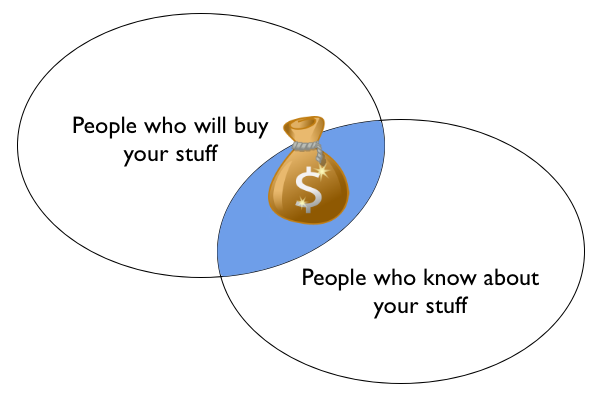
It doesn’t matter how big either of the two sets is, in itself: what matters is by how much they overlap. If everyone on Earth knows about your stuff, but doesn’t want it or can’t afford it, you’ll starve. Conversely, even if a billion people want, need, and would happily buy your product, but they’ve never heard of it, you’ll still starve. Your business will live or die based on the size of the intersection in this Venn diagram. (High school math turned out useful after all!)
Build your castle on your own land
It makes sense to create a single website where people can go to find out about your business. This will be the hub of your marketing efforts, so ideally it will also be the place where people can buy your products.
The website is essentially the home of your brand. It’s well worth investing a little to get your own DNS domain (maybe $15 a year) and web hosting ($20/month): once you’ve bought your land, you get to keep all the value you add to it.
Rule #1: Build your castle on land you own
—Don’t Build Your Castle in Other People’s Kingdoms
Only in your own kingdom can you truly be in control. Other people’s kingdoms may offer you greater visibility, but there’s always an ulterior motive, and it’s usually profit—for them, not for you.
For example, if you write a tutorial or blog post on Medium, you’re building business value for Medium, not for yourself. If you post a video on TikTok, you’re building business value for TikTok. If you write a thoughtful essay on LinkedIn, you’re building business value for LinkedIn. You get the idea.
Yes, some crumbs may drop from their table onto yours, but crumbs is about all you’ll get. If you want a square meal instead of a starvation diet, you need to own the table. That means all the value you’re creating should be visible under the name of your brand, not someone else’s.
Your website doesn’t need to be fancy. It just needs to convey three key points about the product (even if that’s you):
- What it is
- What problem it solves
- How to buy it
Just one page with this information, or one page per product offering, is fine. That way, all you need to give out is the link to this landing page, and people can go there to find out everything they want to know.
“Take my money!”
Remember, the whole point of your website is to smooth the way as much as possible for people who are excited about your products or services to be able to purchase them. It’s not there to win design awards. It’s there to oblige people who are practically shouting at the screen, “Take my money!”
For example, the article you’re reading right now is an extract from my book Master of Your Domain, and if you follow the link you’ll see the product page for it. The “take my money!” button is right there at the top, but if you need more convincing, you can read about the benefit:
Many engineers dream of working for themselves, but the path isn’t obvious. How do you find clients? How much should you charge? How do you market your work without feeling like a salesperson? Where does money come from when you’re not employed by a company?
This book is a complete manual for the self-driving independent engineer. It covers everything you need to know: finding customers, pricing your work, creating products, building a sustainable business around your expertise, and creating the freedom to choose your own direction.
You can read the table of contents and a sample chapter, read more excerpts right here on the blog, and see a bunch of enthusiastic reviews from people who absolutely love the book (and have successfully started their own businesses as a result of reading it).
There are a zillion other pages on my website, some of them moderately interesting, but this is the most important of all: it’s the page that actually creates sales. If someone landed on this page randomly, they wouldn’t need to read the rest of the site to figure out what the product actually is: it’s all there.
A useful question to ask yourself when you look at your website is: “How many clicks does it take a visitor to give me money?” Ideally, the answer should be “one”, of course. But if it’s higher than this, as it sometimes has to be, you should still work to keep it as low as possible.
Every extra click, button, page, or form field is a hurdle at which some potential customers will fall. Sweep all these obstructions grandly aside and welcome your free-spending visitors with open arms. Put the “buy” button right in their eye-line, and make the purchase process as easy and painless as possible.
Show the product, explain the benefit
Keep it simple and clear. Focus on communicating the benefit people will get from the product. That may be perfectly obvious to you, but it won’t be to people who’ve never heard of you or your stuff. Explain why what you’re selling is important to them.
For example, suppose your product is a programming course in Go. You may think you’re selling a course, but what people are actually buying is the chance to improve their Go skills. Make that your offering: “Improve your Go!”
When you explain the merits of the product, you needn’t use extravagant language: people tend to disregard hyperbole. On the other hand, it doesn’t pay to be too matter-of-fact. After all, you’re not under oath.
It’s all about presenting the truth in an engaging and positive way. I just bought a fan for my office that says on the box: “Arguably the greatest fan ever invented”. Well, everything’s arguable, I suppose. And it is a pretty good fan.
Growing the bubble
Once you’ve decided on your business’s value proposition and built a small but serviceable website for it, how can you get the message out to people? In other words, how can you start to grow the Venn diagram bubble of “people who know about your stuff”?
Just being a voice crying in the wilderness doesn’t really work. Most of us are pretty resistant to marketing messages, especially uninvited ones. On social media, we see sponsored posts and adverts that we don’t really want to; on forums and link-sharing sites we see thinly-veiled commercial messages masquerading as genuine content; we get emails we didn’t ask for about products we don’t want.
Getting through to people who are well-trained to tune out your message is tricky, and the answer is not simply to shout louder. Instead, get them to come to your castle, where you can talk to them using your inside voice.
You also want to reach as wide a range of people as possible. I’ve noticed that when one friend mentions a product to me, I’ll say, “Huh, sounds interesting.” When a second friend mentions it, I’ll think, “Maybe this is something I should look at.” And if a third friend mentions it, that’s enough to get me thinking seriously about buying it.
This is what I call the “camel’s back” theory of marketing: if you can arrange for a potential customer to hear about you from enough different places, you’ll create a critical mass. Result: cha-ching!
In the next post, we’ll talk about what I think is the most important, and most valuable, way to market to people who want to hear from you: your mailing list. Why not join mine in the meantime?